
Make sense of the live table before you play
A practical look at streamed dealing, baccarat hand rules, table formats, betting odds, mobile play and the realities of AUD payments.
Live Baccarat in Australia: The Game Behind the Stream
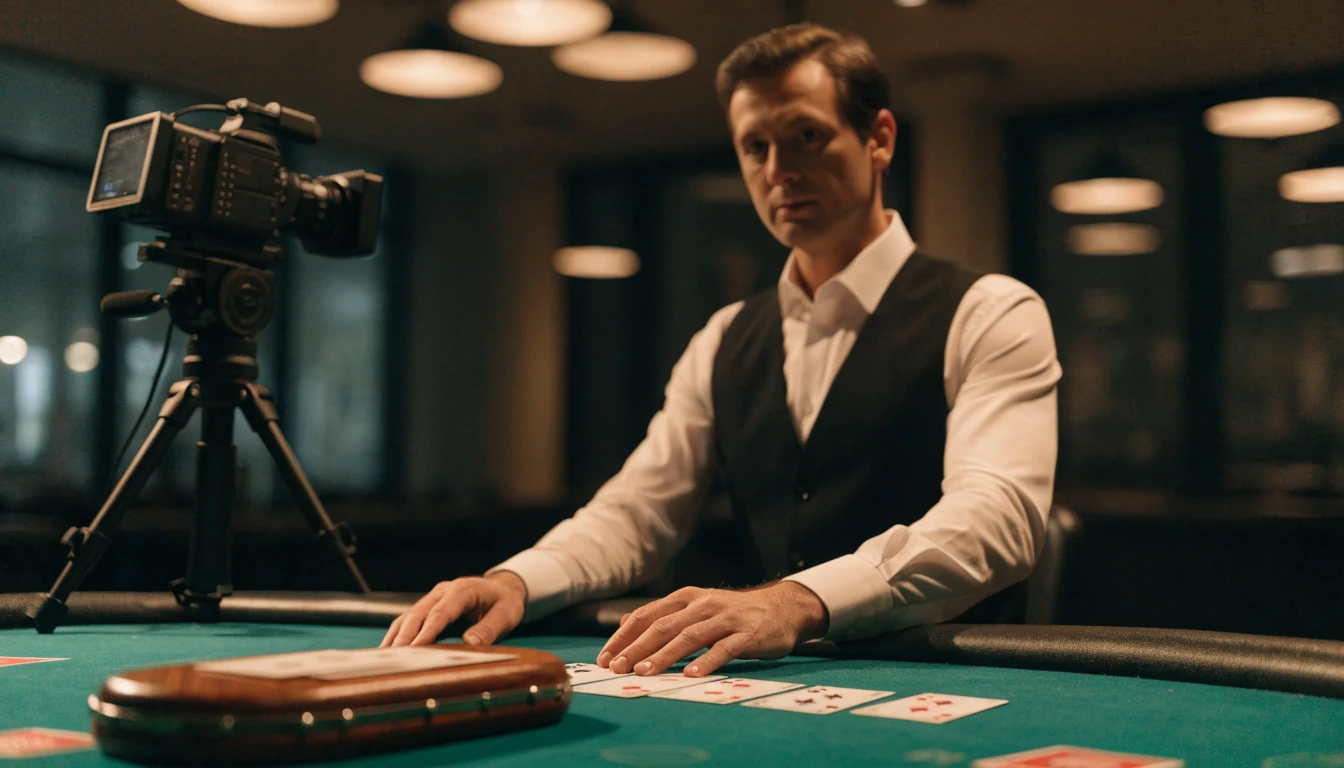
A live baccarat table begins with a person, not a random-number display. A dealer sits in a studio, handles physical cards and deals them across a table filmed by cameras. The stream carries that scene to a screen, while the game interface lets participants place bets as the hand unfolds. It is part card game, part broadcast: the cards are tangible, but the table is encountered through a camera lens and software.
That distinction is the point of live dealer baccarat. The dealer’s movements are visible, and the cards are dealt in real time rather than represented by an animation generated from a digital result. A webcam stream shows the action; the interface connects it to betting. The image may be polished, the studio carefully lit, the camera angle fixed. Yet the central event remains physical: a dealer turns cards, and a hand takes shape in front of the lens.
The format carries an old social quality into a new setting. Baccarat has long been associated with formal tables and composed rituals; the streamed version keeps the visible dealer and the shared focus on a hand, while removing the need to be in the same room. The table becomes a small broadcast set. A player may be watching alone, but the dealer’s presence makes the game feel less like a calculation running behind a screen and more like a public event reduced to a private window.
 Live Blackjack Online in Australia: Laws and LimitsLearn why Australian-licensed operators cannot offer online casino games, and how the article assesses sites, crypto payments and blackjack claims.
 Pokies Tips and Tricks: What Players Can ControlLearn how session boundaries differ from claims about changing spin outcomes, with guidance on RTP, budgets, bonuses and examples including Dragon Link.
That feeling should not be confused with a different outcome system. RNG baccarat, short for random number generator baccarat, uses algorithm-based software to determine results rather than physical cards dealt by a studio dealer. Its interface may display cards and table graphics, but there is no live dealer handling a real shoe in the stream. Both formats offer baccarat; they differ in how the result is produced and presented. One puts a physical deal on camera. The other relies on software.
For Australian audiences, the setting has an important legal boundary. There are no locally licensed online casinos officially operating in Australia, and the Interactive Gambling Act 2001 prevents Australian-licensed operators from offering online casino games. The fact that international platforms may accept Australian players does not make their casino services locally licensed or turn them into a domestic market. Australian residents do play online baccarat through such platforms, where live dealer and RNG versions may both appear, but that availability is not an endorsement or a statement that the services are lawful to provide in Australia. The line is plain; the screen can make it look less so.
This is one reason the phrase “live baccarat in Australia” can describe two different things at once: a game viewed by people in Australia, and a regulated local casino product. They are not the same. A streamed table may look geographically close, with a dealer speaking to the camera and a betting window open on a nearby device. The legal status of the service, however, does not change with the studio’s location or the ease of reaching a webpage. A broadcast can travel farther than the permission behind it.
The social element also has limits. Some live tables allow players to chat with the dealer or other participants, creating a brief sense of company around the cards. The interaction is real in the modest, practical sense that a dealer prompts betting and responds through a live feed. It does not make the table a local venue, nor does it guarantee that every stream offers the same features. The format is assembled from camera, dealer, interface and connection; each is part of the experience, none is the whole of it.
The attraction is easy to understand without dressing it up. Physical cards lend the outcome a visible sequence, while the streamed dealer supplies a human focal point absent from a purely algorithmic display. The camera turns a distant studio into a scene that can be watched as it happens. Still, spectatorship does not remove chance, and the presence of a person dealing does not make a wager safer or more predictable.
A human hand. A remote table.
This page is for adults aged 18 and over. Gambling can cause financial harm, and losses are possible; Winsharkinfo-au.com is not liable for gambling losses. The legal distinction around online casino services in Australia remains more than a technicality, even when a familiar game arrives as a polished live stream.
What “Best” Can Mean When the Market Has No Local Casinos
Top operators
Choosing a live baccarat casino is about finding an option whose available details suit your priorities, from licensing information to deposit and payout terms. Use these verdicts as a concise reference when considering live baccarat online in Australia.
-
7Bit Casino
- License
- Curacao, operated by Dama N.V.
7Bit Casino is operated by Dama N.V. and lists a Curacao license.
-
Golden Pokies
- License
- Curacao
Golden Pokies lists a Curacao license. No other operator details are provided here.
-
Rollero Casino
- License
- Curacao Gaming Control Board OGL/2023/176/0095 (Hollycorn N.V.)
Rollero Casino lists Curacao Gaming Control Board license OGL/2023/176/0095 and is operated by Hollycorn N.V.
-
GoldenCrown
- License
- Curacao Gaming Control Board OGL/2023/176/0095 (Hollycorn N.V.)
GoldenCrown lists Curacao Gaming Control Board license OGL/2023/176/0095 and is operated by Hollycorn N.V.
-
Ricky Casino
- Payout speed
- crypto under 1 hour, PayID 1-3 business days
- Min. deposit
- A$20 (A$30 to qualify for the bonus)
Ricky Casino lists crypto payouts under an hour and PayID payouts in 1–3 business days. Its minimum deposit is A$20, or A$30 to qualify for the bonus.
-
Thor Casino
- License
- Curacao – Antillephone N.V. (Versus Odds B.V.)
- Min. deposit
- EUR 20
Thor Casino lists a Curacao license from Antillephone N.V. (Versus Odds B.V.). Its minimum deposit is EUR 20.
-
MrPacho
- Payout speed
- crypto 30-120 minutes, fiat 24-72 hours
- Min. deposit
- A$30
MrPacho lists crypto payouts in 30–120 minutes and fiat payouts in 24–72 hours. Its minimum deposit is A$30.
-
SkyCrown
- License
- Tobique Gaming Commission
- Payout speed
- crypto ~10-15 minutes, fiat 1-5 days
- Min. deposit
- A$30
SkyCrown lists a Tobique Gaming Commission license, with crypto payouts of about 10–15 minutes and fiat payouts in 1–5 days. Its minimum deposit is A$30.
-
Uptown Pokies
- License
- Curacao (operating since 2017)
- Min. deposit
- A$20
Uptown Pokies lists a Curacao license, has been operating since 2017, and has a minimum deposit of A$20.
-
LevelUp Casino
- License
- Curacao eGaming OGL/2023/174/0082 (Dama N.V.)
- Min. deposit
- A$15
LevelUp Casino lists Curacao eGaming license OGL/2023/174/0082 and is operated by Dama N.V. Its minimum deposit is A$15.
“Best” normally suggests a field of comparable choices: operators working under the same rules, accountable to the same regulator, and offering services that can be judged against a common standard. In Australian online baccarat, that premise does not hold. There are no locally licensed online casinos officially operating in Australia, and the Interactive Gambling Act prevents Australian-licensed operators from offering online casino games.
That absence is not a footnote to a comparison. It changes what the comparison can honestly claim. A table of supposed winners may look orderly, but it cannot turn an offshore service into a locally licensed casino or make unlike legal arrangements equivalent. “Best” here is less a crown than a label whose limits need stating.
The distinction matters because familiar signals of quality can be mistaken for signs of local approval. A polished site, a detailed game page or a confident promise does not alter the legal position. Nor does a ranking, however neatly arranged. The law concerns the provision of online casino games to people in Australia; describing an operator as the best option does not make that service locally licensed.
For that reason, a responsible comparison cannot be a league table of Australian casinos. It can only describe what can be checked, and what those checks do—and do not—establish. The essential first question is not which name sits at the top, but whether a claim about local licensing is true. In this market, there are no locally licensed online casinos to rank.

Other claims need similar care. A description of a baccarat service may explain what it offers, but that is not evidence of Australian authorisation. A review may compare features, but comparison is not endorsement and cannot supply a local licence where none exists. These distinctions can seem fussy until money, identity details and expectations are involved. Then they become the substance.
There is also a cultural oddity in the word “best.” It comes from a marketplace in which choice is supposed to settle the question: compare, select, proceed. Regulation interrupts that tidy story. Australia has not established a domestic online-casino market in which local operators compete under a shared casino licensing framework. The absence is not an invitation to fill the gap with offshore rankings. It is a reason to read claims about Australian-facing services with restraint.
A useful editorial standard is therefore modest. Separate a factual description from a recommendation. Do not treat a foreign-facing offer as a locally licensed one. Do not let the visual grammar of a ranking—stars, medals, winners—suggest a regulatory assurance it cannot provide. If a comparison is published, its scope should be plain: it cannot identify a “best” locally licensed online baccarat casino, because that category does not exist in Australia.
This is not the same as saying every service is identical, or that every factual claim about a service is unknowable. It is saying that feature comparisons and legal status answer different questions. One may describe an offer; the other concerns whether online casino games may be provided under Australian licensing. Conflating them makes a commercial judgement look like a public safeguard. It is not one.
The broader Australian approach reflects a choice about what may be supplied, rather than a promise that consumers can pick a domestic casino from a regulated shelf. That choice may sit awkwardly beside the language of rankings, which assumes a row of legitimate local competitors waiting to be assessed. Language can outlive the conditions that once made it sensible.
So “best baccarat casino” can only be handled here as a phrase with a boundary around it. It cannot properly mean the top Australian-licensed online casino: none officially operates, and Australian-licensed operators cannot offer online casino games. A feature comparison must not be mistaken for permission, approval or a recommendation to use an offshore service.
The distinction is the point.
18+ only. Gambling can cause financial harm. This website is not liable for losses.
The Dealer, the Table and the Pace of a Live Hand
A live dealer baccarat table is a small performance built around a camera. The dealer works in a studio, handling physical cards while a stream carries the action to a virtual table on screen. The player’s view is framed by the equipment: cards, felt, hands and the dealer’s movements. The room itself may be elaborate or spare, but its practical purpose is the same—to make each action visible.
That visibility changes the texture of play. An algorithm can produce an outcome without anyone watching it happen; a live table gives the outcome a sequence. Cards are handled, dealt and revealed in front of the camera. The stream is not merely decoration around a digital result. It shows a human dealer carrying out the hand, while the table interface provides the place for remote participants to follow the action.

A professional dealer keeps the sequence moving and the table legible. There is a formal rhythm to the work: attention shifts between the cards, the camera and the interface, and the dealer’s actions mark one stage of a hand before the next begins. The virtual table is therefore both a game surface and a viewing frame. It makes a studio event usable by people who are not physically present.
Some tables provide chat, allowing players to exchange messages with the dealer or one another. A specialist review describes this as a feature that may be available, rather than an element to assume at every table. Where it exists, chat adds a social layer, though it does not alter the cards or the game’s procedure. The distinction matters: conversation can make a streamed table feel less solitary, but the game remains governed by its rules, not by the mood of the room.
The pace is another part of the table’s character. A specialist review gives standard live baccarat a rate of about 40–50 hands per hour, compared with more than 80 at Speed tables. These figures describe a reported format difference, not a promise about every session. Standard tables leave more room for the visible transitions between hands; Speed tables compress those pauses and move more quickly from one round to the next.
Speed is not simply a matter of watching cards arrive sooner. A faster cadence means decisions and outcomes follow one another with less breathing space. The studio may still look composed, but the player’s experience can feel more continuous, with fewer pauses in which to take stock. Standard play offers a slower beat. Neither format changes the basic identity of the game, yet the tempo can shape how much attention the session demands.
Standard Tables
Features a slower beat with a reported pace of approximately 40–50 hands per hour.
Speed Tables
Compresses pauses between rounds with a reported pace of more than 80 hands per hour.
Schedules can also affect when a table is available. A specialist review notes that live baccarat timetables may include time restrictions, so the published schedule is relevant to availability. Studio tables are operated, not conjured on demand. The human element has a clock.
That is the quiet difference between a live table and a purely software-driven one: the stream exposes the work that a digital interface might otherwise conceal. The dealer’s hands, the camera’s framing and the table’s pace make the session feel observed and shared, even when each participant is remote. A polished set cannot make the arrangement local or remove the financial risk of gambling.
18+ only. Gambling can cause financial harm. Winsharkinfo-au.com is not liable for losses.
Baccarat Variants: Traditional Commission and the No-Commission Trade-Off
The difference between traditional baccarat and No Commission Baccarat is not a different contest between Banker and Player. It is a change in how a winning Banker wager is paid. The distinction can look small on a game panel; over repeated hands, it changes the arithmetic that sits behind the table.
In the traditional format, a winning Banker bet carries a 5% commission. The convention reflects a built-in advantage for the Banker side: rather than paying a full even-money return on every Banker win, the table deducts commission from the winnings. The deduction is part of the format, not a service fee added later. A posted rule sheet should make clear how the charge is calculated and when it applies.

No Commission Baccarat removes that commission from winning Banker bets. The name sounds like a simple improvement, as if a charge has vanished without consequence. The trade-off is that the game may adjust payouts for certain Banker totals instead. A specialist review reports this alternative structure, but the exact adjustment belongs to the rules of the specific table. The label alone does not reveal which Banker outcomes receive a changed payout or what that payout will be.
That is the point at which the two formats should be compared: not by their names, but by their full payout terms. A player considering a particular baccarat casino game needs to distinguish the absence of a commission from the absence of a cost. In No Commission Baccarat, the adjustment may be embedded in the return on a qualifying Banker win rather than shown as a separate deduction. The accounting moves; it does not necessarily disappear.
The underlying wager choices remain familiar. Bets can be placed on Banker, Player or a tie, and the hand closest to nine wins. Those shared features can make traditional and no-commission tables appear nearly identical in a lobby. Their meaningful difference lies in the Banker settlement rule, so the table’s game rules matter more than a short title or promotional description.
This is also why a generic comparison of baccarat casino games can mislead. Two tables with the same broad format may not explain the commission or payout adjustment in the same way on screen. One may show a commission deduction after a winning Banker result; another may state a reduced payout for a specified Banker total. Before treating either format as more favourable, the terms have to be read as a whole: the bet, the result that qualifies, and the return attached to it.
Do
- Check the full payout terms for Banker wins.
- Read the specific table rules for payout adjustments.
- Distinguish between absence of commission and absence of cost.
Don't
- Rely on labels like "No Commission" as a simple improvement.
- Assume all no-commission tables have identical payout structures.
- Ignore the embedded costs in altered Banker payouts.
No Commission Baccarat is therefore not simply traditional baccarat with a more attractive label. It replaces a visible deduction with a possible change to particular payouts. Traditional commission baccarat, by contrast, makes the deduction explicit. Each method makes the cost legible in a different place, and neither name settles which is preferable without the table’s actual rules.
In Australia, this distinction is descriptive, not an invitation to play. The Interactive Gambling Act 2001 prohibits operators from providing real-money online casino games to people physically located in the country. Baccarat variants may be discussed as game formats, but that does not make an online casino service lawful to offer locally.
For anyone studying the format, the practical distinction is narrow: check whether the Banker win incurs commission or whether specified Banker totals receive altered payouts. The terms decide it. Labels do not.
18+ only. Gambling can cause financial harm. Winsharkinfo-au.com is not liable for losses.
Playing a Hand on a Phone or at a Table
A live baccarat screen turns a compact card game into a sequence of choices made against a clock. The table presents three betting areas: Player, Banker and Tie. A stake placed on one of them backs that outcome; the hand nearer nine is the winner. The labels describe the two sides of the deal, not the people seated at a table. A player can back either side.
In a digital interface, the process is presented through selectable areas on the table image. A participant chooses an outcome and confirms a stake while betting is open. Once the dealer begins the hand, the betting window closes; the cards are dealt, the result is settled, and the table opens for another round. The screen supplies the buttons, but not a different game. The essential decision remains which result to back.

On a phone, the same layout is compressed rather than fundamentally changed. A specialist review reports that live baccarat is available on Android and iOS devices. The table image and controls must share a smaller display, so the placement of buttons or score information can differ from a desktop version. The underlying sequence—select a side, place a stake, wait for the hand to settle—remains recognisable. Touchscreens make the table portable; they do not make its risks smaller.
Trial access is a separate matter from the way the interface works. A specialist review describes trial play as possible but constrained by the limited seats available at a live table. Unlike a computer-generated demonstration, a streamed table has a dealer and a finite playing environment. Access to a trial seat can therefore depend on what the particular table offers. A displayed practice option should not be assumed to be available for every live game.
The same review notes that live dealer games are often offered only for real money, which means a bankroll is required where that format is available. That distinction matters: a live stream is not automatically a free demonstration simply because it resembles a game on a screen. In Australia, however, the legal setting cannot be treated as a footnote. The Interactive Gambling Act 2001 prohibits operators from providing real-money online casino games to people located in Australia. This description is not an invitation to use an offshore service.
A baccarat table’s apparent simplicity can obscure how quickly a stake becomes a financial decision. The betting choices are few; the consequences are not. Gambling can cause financial harm, and Winsharkinfo-au.com is not liable for losses. 18+ only. Responsible gambling means recognising when play is no longer affordable and seeking support where needed.
Reading a Baccarat Lobby Before a Session
A baccarat lobby is arranged to make comparison look simple: table names, stake ranges, game speeds and availability sit in tidy rows. For Australians, that display has to be read against a less tidy legal setting. The Interactive Gambling Act 2001 prohibits operators from providing real-money online casino games to people in Australia; there are no locally licensed online casinos. A lobby’s presence on a screen does not make an offer lawful or locally regulated.
Where table information is available, the minimum stake is a practical detail, not decoration. One specialist review reported live baccarat minimums of $5–$10 per hand and described $1 tables as uncommon. That is a snapshot, not a dependable market-wide rule: limits can vary by table and change. A table’s stated minimum also says nothing by itself about whether its pace or other conditions suit a player.
The schedule deserves a separate check. Live tables may have time restrictions, so a listed game is not necessarily available whenever the lobby is open. The schedule can show when a table operates and whether its hours fit a particular session. It is a small administrative detail with outsized influence: the dealer may be live, but the table is not necessarily waiting.

Speed labels matter for a different reason. A specialist review put standard live baccarat at roughly 40–50 hands an hour, compared with more than 80 for Speed tables. These are reported rates, not guaranteed output; table operation can vary. Still, the distinction is plain. A faster table compresses the interval between decisions, while a standard one leaves more space between hands. Pace affects how quickly a bankroll is exposed to repeated stakes, even when the rules themselves have not changed.
A careful lobby comparison therefore separates what is plainly stated from what is only suggested: minimum stake, schedule, and whether the table is marked standard or Speed. Missing or vague details are not evidence of favourable terms. Nor does a polished interface answer the more consequential question of whether the service is lawfully offered in Australia.
This is not a recommendation to use offshore casino services. Australian law prohibits operators from supplying real-money online casino games to people in the country, and access to offshore services may be blocked. Gambling can cause financial loss; Winsharkinfo-au.com is not liable for losses. 18+ only. Gambling can be harmful.
Bonuses, Betting Odds and the Cost of the Tie
A baccarat bonus can look like extra playing money, but its practical value depends on the conditions attached to it. Wagering requirements set out how much qualifying play is needed before bonus funds, or winnings connected to them, can be withdrawn. The game’s contribution rate matters: if live baccarat counts for only part of the required wagering, a hand does less to meet the condition than its stake might suggest.
A specialist review reports live baccarat contribution rates of 5–15% toward wagering requirements. That is a reported range, not a fixed rule for every offer. Terms can differ, and the contribution assigned to baccarat should be read alongside any other conditions. A headline bonus, by itself, says little about how much qualifying play it entails.
The underlying odds are a separate calculation. In live baccarat, the Banker bet has a house edge of 1.06%, while the Player bet has an edge of 1.24%. The difference is small, but it means the Banker wager carries the lower mathematical disadvantage of the two. Neither figure predicts the result of a particular hand; they describe the long-run edge built into the game.
The Tie wager is a different proposition. Its house edge is 14.36%, markedly higher than the edges on Banker or Player. The larger potential payout associated with a tie does not erase that cost. A dramatic return on an occasional result can coexist with a less favourable expectation across repeated bets. The arithmetic is unsentimental.
Bonuses do not change those house edges. They may affect the terms under which funds can be used or withdrawn, but they do not make a Tie bet mathematically cheaper, or turn a Banker bet into a guaranteed outcome. Comparing an offer with the game therefore requires keeping two questions apart: what the wager’s house edge is, and how the bonus counts the wager.
There is also a legal boundary in Australia. Under the Interactive Gambling Act 2001, operators cannot provide real-money online casino games to people physically in Australia. This discussion is informational, not a recommendation to seek or use an online casino bonus.

18+ only. Gambling can cause financial harm and losses; Winsharkinfo-au.com is not liable for gambling losses. If gambling is causing harm, seek support.
The Scoreboard, the Cards and the Arithmetic of Nine
A baccarat scoreboard is a record of completed hands, not a forecast. Its marks help follow which side has won from hand to hand, while the arithmetic underneath remains deliberately spare: the Player and Banker each receive a hand, and the side nearer nine wins. A run of marks can look persuasive; it does not alter the next deal.
Card values explain why the displayed total may seem smaller than the cards suggest. Picture cards count as zero. When a hand’s sum passes ten, the digit on the left is discarded, leaving the right-hand digit as the baccarat total. Thus a sum of ten becomes zero, while a sum of twelve becomes two. The aim is not to build the largest ordinary card total. It is to finish nearest nine after this reduction.
That small rule does most of the work. A hand that appears to exceed the target can, after the left-hand digit is dropped, sit close to it—or far away. The scoreboard’s total is therefore not a conventional sum carried forward from one card to the next; it is the remainder used to compare the two hands. No accumulating score.
The dealing pattern also affects what appears on the table. If a hand’s total is under five, another card is dealt. The resulting card changes that hand’s total under the same arithmetic, and the comparison is made once the dealing is complete. A scoreboard can make this sequence easier to follow, but its rows and marks are records of outcomes, not evidence that a particular side is due.
Baccarat Arithmetic
-
1
Card Valuation
Picture cards are valued at zero, and totals are reduced to the right-hand digit (e.g., a sum of 12 becomes a total of 2).
-
2
Hand Comparison
Two hands are dealt, and the side that finishes nearest to the value of nine is declared the winner.
-
3
Outcome Recording
Completed hands are marked on the scoreboard as a record of results, though this does not predict future deals.
This is the useful distinction between reading the display and reading meaning into it. The cards provide the inputs; reducing a total to its right-hand digit provides the value; the side closest to nine takes the hand. The board remembers. It does not predict.
In Australia, real-money online casino games are prohibited for operators under the Interactive Gambling Act 2001. This description is informational, not an invitation to play. 18+ only. Gambling can cause financial loss; Winsharkinfo-au.com is not liable for losses arising from gambling. The sensible arithmetic is the arithmetic of risk.
AUD Payments and the Offshore Withdrawal Question
Payment methods described in Australian-focused specialist reviews include PayID, bank transfers, Visa and Mastercard, e-wallets and cryptocurrency. Their appearance on a payment page does not make an online casino lawful to operate in Australia. The Interactive Gambling Act 2001 prohibits operators from providing real-money online casino games to people in the country, and this section is not an invitation to use offshore services. Credit cards should not be used for online gambling.
Currency can alter the amount that arrives, even when the balance looks straightforward. An account held in Australian dollars avoids the 2.5–4% conversion margin that may be applied to balances in US dollars or euros. With a foreign-currency wallet, the displayed stake and the amount ultimately charged in Australian dollars may differ. The exchange step is not a baccarat rule, but it can become part of the cost of a session.
The more consequential uncertainty may come at withdrawal. A specialist review reports weekly withdrawal caps of $5,000–$10,000 at offshore sites; those terms vary and should not be treated as a universal limit. A cap can shape how quickly funds may be released, quite apart from the table’s rules or the speed of a hand. The cashier terms, currency conversion policy and withdrawal conditions are separate parts of the arrangement.

A smooth deposit is not proof that a withdrawal will be equally simple. Nor does a familiar payment method establish local authorisation. The distinction matters in a market where Australian-licensed operators cannot offer online casino games, while offshore services remain prohibited from supplying them to people in Australia.
18+ only. Gambling can cause financial harm. Winsharkinfo-au.com is not liable for gambling losses.
The Rules That Decide a Baccarat Hand
Baccarat’s central contest is between two hands: Banker and Player. A third possible outcome is a tie. Before the deal, a wager is placed on which result will occur; the labels describe the hands, not the people at the table. The dealer’s task is to complete the hand according to the game’s rules, while the players’ wager remains a prediction about the outcome.
The winning hand is the one closest to nine. If Banker finishes nearer to nine, a Banker wager wins; if Player is nearer, the Player wager wins. When the hands finish at the same total, the result is a tie. That simple comparison is the hinge on which casino baccarat rules turn. The ceremony may be elaborate; the decision is not.

A tie is an outcome in its own right, not a third hand competing to beat Banker and Player. The distinction matters because a bet on one side and a bet on a tie are different predictions. No strategy changes the rule: the hand nearest to nine takes the result.
Baccarat has long dressed a spare contest in formal manners. Cards are dealt, totals are compared, and the table waits for the outcome. The rules do not require a player to make decisions during the hand.
In Australia, the Interactive Gambling Act 2001 prohibits operators from providing real-money online casino games to people in the country. This description is not an invitation to gamble.
18+ only. Gambling can cause financial harm. Winsharkinfo-au.com is not liable for gambling losses. If gambling is causing harm, seek support.
Are there live baccarat casinos in Australia?
Australians can access live baccarat on international casino platforms that accept Australian players, but there are no locally licensed online casinos officially operating in Australia.
Can you play live dealer baccarat online?
Yes. A live dealer handles physical cards at a studio table, and the game is streamed to your device while you place bets through the online interface.
What is online live baccarat?
It is baccarat played through an online stream of a real dealer dealing physical cards. Players bet on the Banker, Player or Tie, and the hand closest to nine wins.
Is online baccarat legal in Australia?
Australian-licensed operators cannot offer online casino games under the Interactive Gambling Act 2001, and there are no locally licensed online casinos officially operating in Australia. International platforms may accept Australian players, but that does not make them locally licensed.
How can you win live online baccarat?
No betting choice guarantees a win. The Banker bet has the lowest stated house edge at 1.06%, compared with 1.24% for Player and 14.36% for Tie.